Kerbalhopper: PID explained with KSP
2023-04-30
Introduction
The Starship test flight by SpaceX is incredibly thrilling! True to your
old habits, you've determined to recreate it in Kerbal Space Program.
Perhaps it would be wise to begin by constructing a Starhopper replica.
After all, you just need to take off and maintain your altitude for a few
seconds, right?
The rocket design is straightforward. All you need to do is affix a Dart
engine beneath a Rockomax Fuel Tank, integrate landing legs, a probe core
and battery together, and you're ready to launch.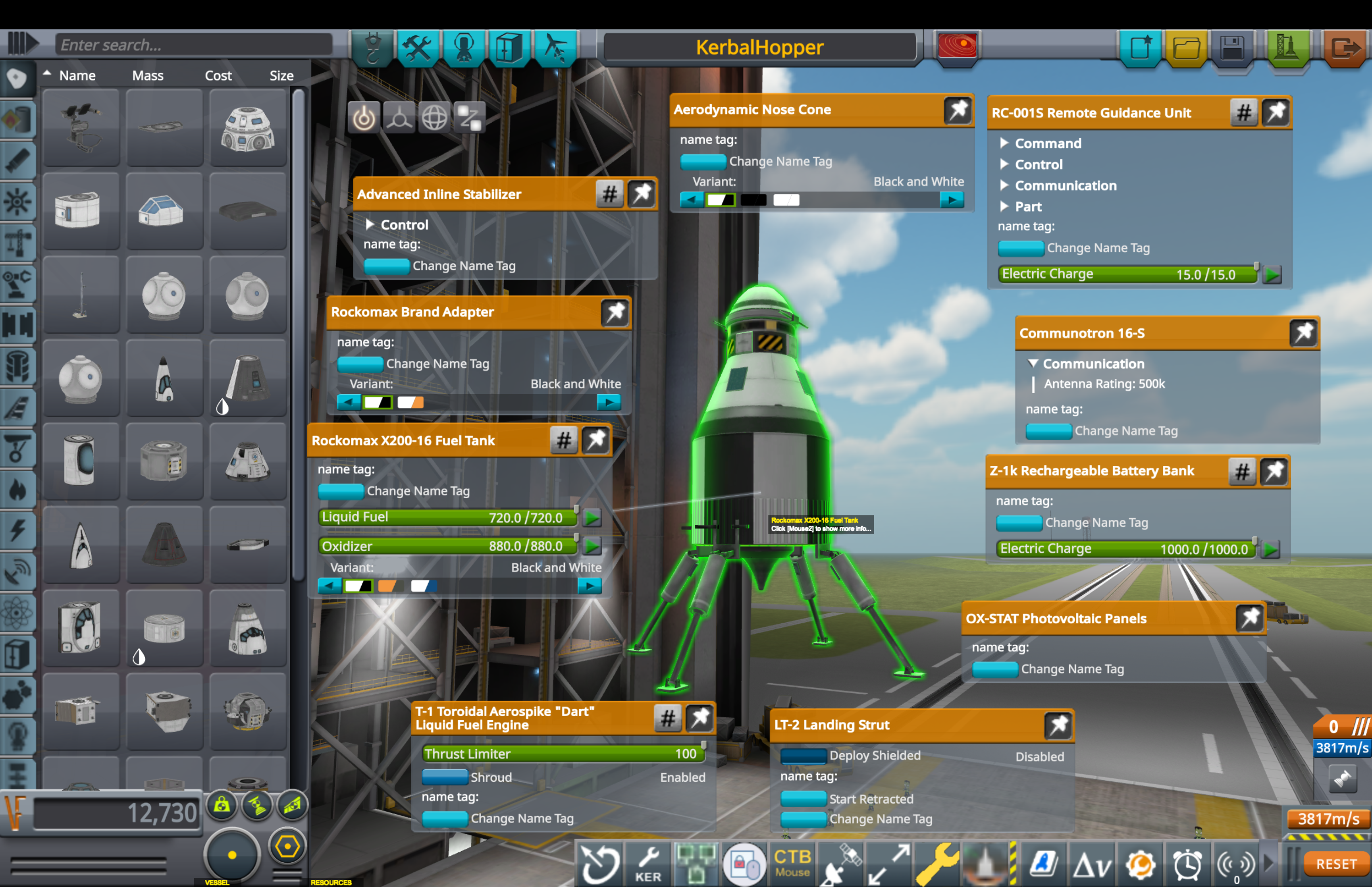 KerbalHopper Craft
After fiddling aroud with
this craft, you decide
to automate this go-to-an-altitude-and-hold-it process. Being a
programmer, automation comes naturally to you.
Thanks to the community, a mod called
krpc exposes the underlying API of
KSP. You can use it to write a script that controls your craft.
The math way
You want to figure this problem out by turing it into an optimization
problem. In short, you need to figure out a function
\(f: \mathbb{R} \mapsto [0,1], \text{time} \mapsto \text{throttle}\).
According to Newton's law:
\[F = ma\]
while the corresponding \(F\), \(m\) and \(a\) are:
\begin{align*}
& F = f(t) + mg + \text{drag}(\frac{\mathrm{d}x}{\mathrm{d}t}) \\
& m = \text{wet mass} - \text{fuel consumption}(\int_{0}^{t} f(u) \mathrm{d}u) \\
& a = \frac{\mathrm{d}^2 x}{\mathrm{d}t^2}
\end{align*}
And you want at some time \(t_0\):
\begin{align*}
& x = h \\
& \frac{\mathrm{d}x}{\mathrm{d}t} = 0
\end{align*}
Ok it seems that things are getting out of hand. Too many variables are
affecting each other. You wonder if there is a better way to do this. And
it turns out that this is an engineering question: You don't have to
find an optimal solution, you just need to find a good enough one.
The engineering way
Time to be creative!
P
A pretty straightforward way is to let your throttle be proportional to
how far you still need to fly before reaching height \(h\).
Let \(E = h - x\), then your \(f\) can be written into:
\[f = KE\]
And you implement this into Python:
import krpc, time

HEIGHT = 200
K = 0.01 # Some constant?
DELTA_T = 0.01


class Controller:
    def __init__(
        self,
        target: float,
        k: float
    ) -> None:
        self.target = target
        self.k = k

    def step(self, current: float, dt: float) -> float:
        # f = KE
        error = self.target - current
        return error * self.k


def main():
    conn = krpc.connect(name="KerbalHopper Controller")
    vessel = conn.space_center.active_vessel
    controller = Controller(
        target=HEIGHT,
        k=K,
    )

    input("Press enter to launch.")
    vessel.control.activate_next_stage()

    while True:
        flight = vessel.flight()
        alt = flight.surface_altitude
        throttle = controller.step(
            current=alt,
            dt=DELTA_T
        )
        vessel.control.throttle = throttle
        print(
            "Altitude: {alt} Throttle: {throttle}".format(
                alt=alt,
                throttle=throttle,
            )
        )
        time.sleep(DELTA_T)

if __name__ == "__main__":
    main()
After a few trials, you find that the craft isn't going anywhere no matter
what \(K\) is. Ship keeps oscillating dramatically between \(30\) and
\(230\). This method need some workarounds.
D
Recall what you do when you're trying to maintain the altitude: When
you're approaching the height, you try not to let the ship fly too fast.
How do you describe not going too fast while approaching? Yes that's
\(-\frac{\mathrm{d}x}{\mathrm{d}t} = \frac{\mathrm{d}E}{\mathrm{d}t}\).
Again, you take the value, snap a content \(K_d\) onto it and hope this
works.
\[f = K_p E + K_d \frac{\mathrm{d}E}{\mathrm{d}t}\]
And you implement this in Python:
import krpc, time

HEIGHT = 200
KP = 0.02
KD = 0.008 # Some more constant!
DELTA_T = 0.01


class Controller:
    def __init__(self, target: float, kp: float, kd: float) -> None:
        self.target = target
        self.kp = kp
        self.kd = kd
        self.last_error = 0

    def step(self, current: float, dt: float) -> float:
        error = self.target - current

        p = error * self.kp

        # discrete version of dE
        dE = (error - self.last_error) / dt
        d = self.kd * dE

        self.last_error = error
        return p + d


def main():
    conn = krpc.connect(name="KerbalHopper Controller")
    vessel = conn.space_center.active_vessel
    controller = Controller(
        target=HEIGHT,
        kp=KP,
        kd=KD,
    )
    # ...snip
The method is working! The ship now tends to keep its throttle in an
appropriate range. \(K_p\) is controlling how fast you want to
reach \(h\) and \(K_d\) is controlling how ease reaching
\(h\).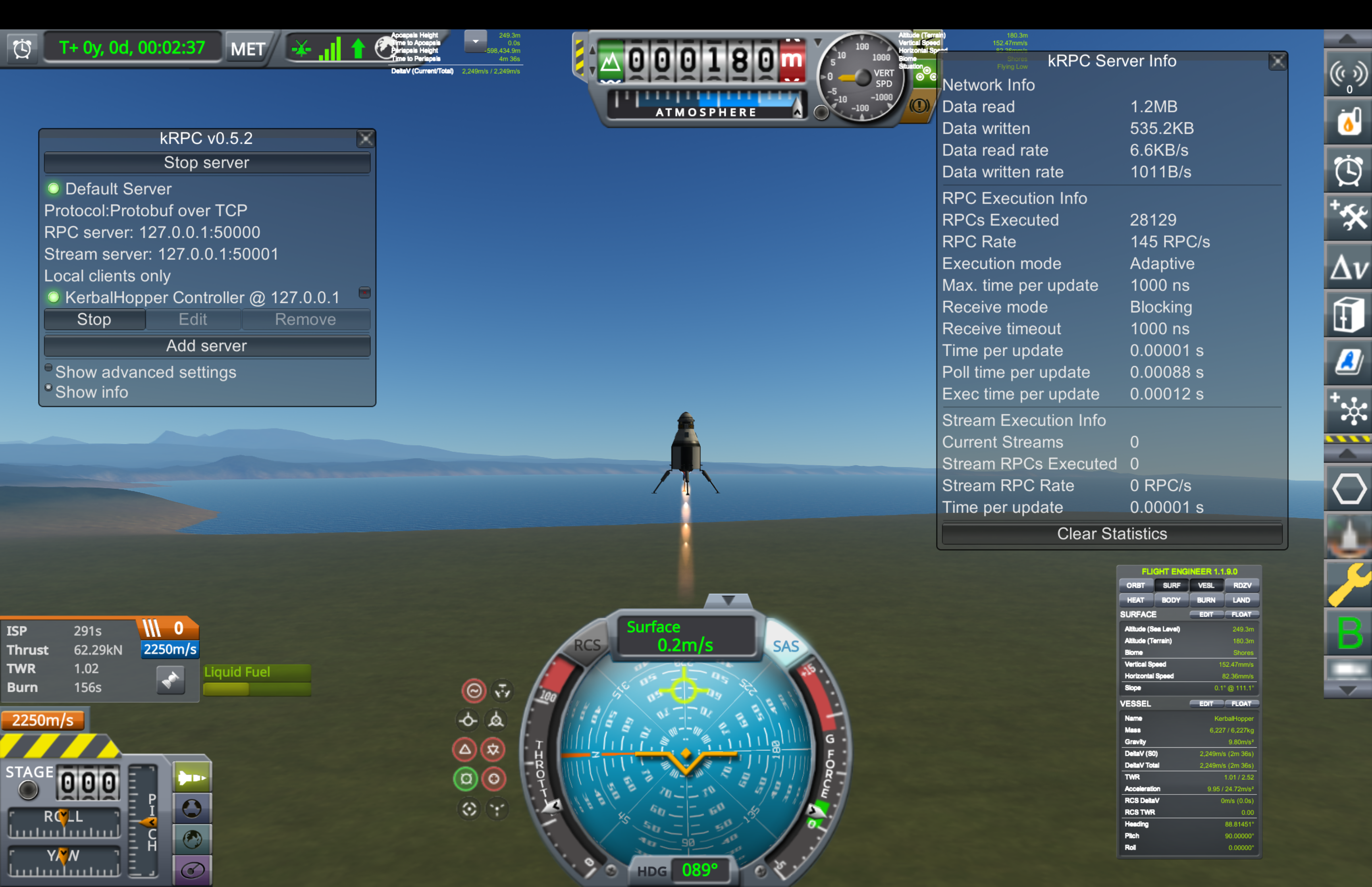 Floating at alt 180
However, the ship stuck at somewhere beneath \(200\). You pick up a pen
and try to figure out where it reaches the balance, that is
\(\text{thrust}=\text{gravity}\):
\begin{align*}
f = mg \\
K_p (h-x) + 0 = mg \\
x = -\frac{mg}{K_p} + h
\end{align*}
\(h-x = \frac{mg}{K_p}\), which means that the rocket can never reach
target height \(h\)!
I
You have tried to taking \(E\) and \(E'\) into account however none
of them helped. What will you do if you observe your ship is not going to
reach \(h\)? As time goes by you will gradually become impatient and
throttle up. How to measure yourself losing patience? Yes that's
\(\int E \mathrm{d}t\)! As usual, you snap a constant \(K_i\) onto it
and hope this works.
\[f = K_p E + K_d \frac{\mathrm{d}E}{\mathrm{d}t} + K_i \int^{t}_{0} E \mathrm{d}u\]
And you implement this in Python:
import krpc, time

HEIGHT = 200
KP = 0.02
KI = 0.001
KD = 0.01
DELTA_T = 0.01


class Controller:
    def __init__(
            self,
            target: float,
            kp: float,
            kd: float,
            ki: float
    ) -> None:
        self.target = target
        self.kp = kp
        self.kd = kd
        self.ki = ki
        self.last_error = 0
        self.integral = 0

    def step(self, current: float, dt: float) -> float:
        error = self.target - current

        p = error * self.kp

        dE = (error - self.last_error) / dt
        d = self.kd * dE

        i = self.ki * self.integral

        self.last_error = error
        self.integral += error * dt

        return p + d + i


def main():
    conn = krpc.connect(name="KerbalHopper Controller")
    vessel = conn.space_center.active_vessel
    controller = Controller(
        target=HEIGHT,
        kp=KP,
        kd=KD,
        ki=KI,
    )

    input("Press enter to launch.")
    vessel.control.activate_next_stage()

    while True:
        flight = vessel.flight()
        alt = flight.surface_altitude
        throttle = controller.step(current=alt, dt=DELTA_T)
        vessel.control.throttle = throttle
        print(
            "Altitude: {alt} Throttle: {throttle}".format(
                alt=alt,
                throttle=throttle,
            )
        )
        time.sleep(DELTA_T)


if __name__ == "__main__":
    main()
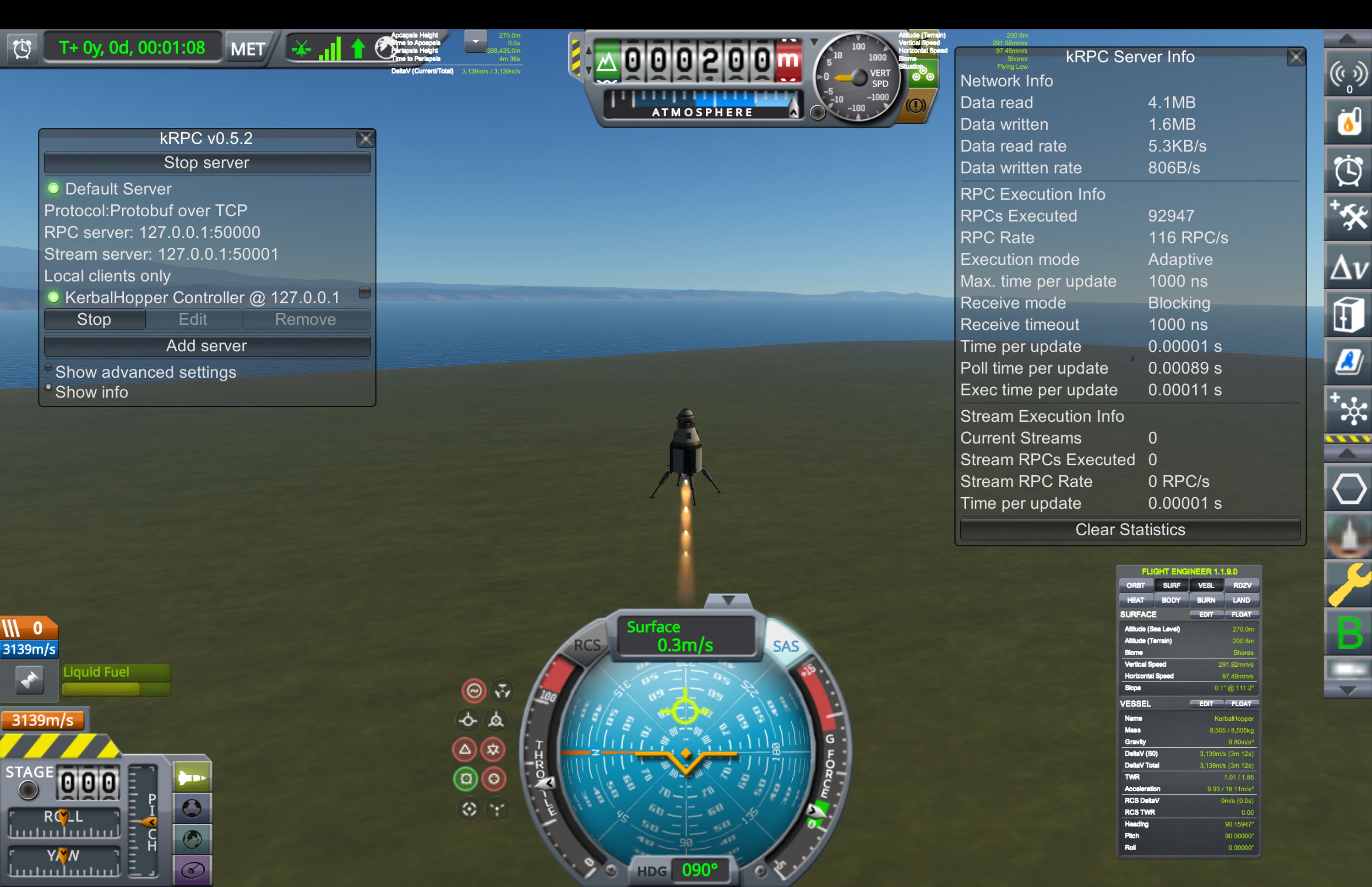 Floating at alt 200
And there you go! Your hard work has paid off. The ship is now floating at
\(200\) meters above the ground. You can now sit back and relax until
it runs out of fuel!
Conclusion
It's such a weird method with some nice symmetrical properties.
\(K_p E\) controls this moment, \(K_d \frac{\mathrm{d}E}{\mathrm{d}t}\)
predicts the future and \(K_i \int E \mathrm{d}t\) reflects the past. You
are fascinated by how easy and effective this 28-line of code is - it made
no assumptions with the system you are interacting. The same laws still
make sense on Duna and Eve. You decide to name it PID, taking the
first letter of Proposal, Integral and Derivative.
...and you find out frustratingly that it was invented in 1940s. There's
even a Wikipedia page
for it.
Source code of this article can be found
here.