On Programming Languages
2024-05-01
While it is true that most of the time while developing software, we just
pick either C++, Java, Python, etc. and start coding simply because A these
languages are already well-established and have a lot of libraries and B we
are already familiar with them. Yet new languages still emerge from time to
time, such as Rust, TypeScript, and Julia, which are happily adopted (and
hated) by developers. But few have thought about what are we actually
creating.
By computation, you mean...
Computers, by definition, compute. And we utilize programming languages to
instruct the computer to compute. However, we actually have no idea what
computing means. You may simply argue against this stating that "Well I
know Turing Machine!" Indeed,
Turing machine is a
great computational model. Along with it also comes the
\(\lambda\)-calculus
(also my blog post),
\(\mu\)-recursive functions,
etc. Surprisingly, these intuitively vastly different models are actually
equivalent in terms of computability, which is known as
Turing equivalent.
We also have created problems that are
undecidable
and uncomputable.
But what makes Turing machine / \(\lambda\)-calculus special? Why do
these (fundamentally identical) computational models decide what is
computable? Back to the question, what is computation? It turns out that
we have no idea. The
Turing-Church Conjecture
states that these computational models are identical because they all
capture the essence of computation. But what is the essence of computation?
It's never formally defined. (You can't define it by stating that Turing
machine means computation, after all the concept "essence of
computation" is there because we have so many coincidentally equivalent
models and that may imply some deeper meaning of being computable.) Maybe
there exist some other models that have different computational power (in
terms of computationability) that we have never thought of. Maybe some
problems are computable but not by Turing machine. We simply don't know.
That's enough metaphysics nonsense. Why would I care?
The fact is while these models are the same in terms of Math, they still
differ in terms of mind and what's more, performance. Functional guys
trying to lure you into their nasty world of \(\lambda\)-calculus because
most of the time functional stuff is more expressive and concise. But you
may fight back saying their code going Stack Overflow because of using lazy
evaluation wrong is hilarious and absurd. Modern languages no longer base
themselves on Turing machine or \(\lambda\)-calculus but
RAM-access machines
simply because the model approximates real-world computers. (It would be
great if LISP machines
still exist.) While it holds that a Turing machine emulates a RAM-access
machine, it does so in
polynomial time, which
is stopping you from
coding like this.
But I don't code using JMP and LOAD/STORE either!
Indeed. Our poor little brains (except
theirs) have
already been proven to not have the ability to code in assembly, and
Haskell isn't just about \(\lambda\)-calculus. Abstraction comes into
place to free our tiny RAM. By abstraction, I would like to elaborate on it
as "working on partial information". For example, I know that whichever
input \(f\) always gives the same output if the input is the same simply
because \(f\) is a function. In the C language, we define functions to
hide away actual procedures working solely on the underlying meaning. Good
languages free our brains and less-en the information we are working on.
It's abstraction all the way down.
And by creating languages you mean...
Abstractions are great, but (in terms of software engineering) when it
comes to abstraction there are no underlying metaphysics implications (thank
god) nor formal definitions. It's about doing whatever the cuss a developer
would like to. In Golang you have interfaces, in C you have
functions, in C++ you have classes, in Haskell, you have functions
all over the place. For
the expression problem,
some choose to dispatch methods vertically while some do it horizontally.
Types are not primitives but abstractions too. Everything is just bits and
bytes, interpreting an IEEE double as a short won't cause any fundamental
troubles, and sometimes we do it intentionally. Types present because most
of the time we want to keep it consistent. All of these show that
abstraction is largely ruled by relativism. That's where LISP comes into
place. It, again I'd like to elaborate as, abstracts abstraction by using
macros. Consider the following program:
(define-syntax unless
  (syntax-rules ()
    ((_ condition body ...)
     (if (not condition) (begin body ...)))))

(unless (= x 0)
  (display "x is not zero")
  (newline))
It defines a macro that expands to
(if (not (= x 0))
    (begin
      (display "x is not zero")
      (newline)))
at compile time. One thing that is truly great about LISP macros is that
you can do arbitrary computation at compile time. For example, for C++ guys
who love classes, there exists CLOS (Common Lisp Object System) that is
written in LISP itself, without going into your
indeed-turing-complete-but-all-cluttered-together-only-god-can-understand-CPP-templating-nonsense.
Don't you play tricks on me
Indeed, a compiler, by its definition, does calculations at compile time.
What LISP provides can be seen as a well-designed, modular compiler
framework. It blurs the line between a language and the tech behind a
language. I think we can happily conclude that by creating languages, we are
creating new ways of abstracting data and procedures that fit our needs. PLs
will just keep evolving. It's not a proven fact, it's some kind of art
created by humans.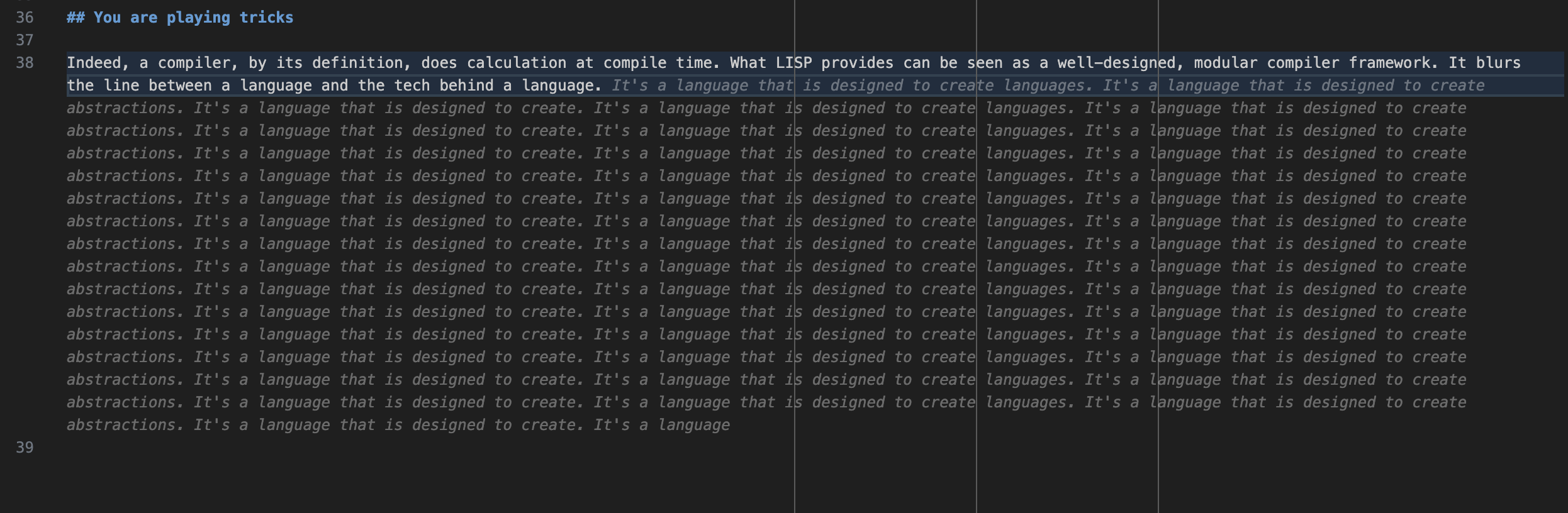 GPT fond of LISP
And it also turns out that even GPT is fond of LISP, so you'd better check
it out.