Simulating Gravitational Lensing
2023-09-03
Ever wondered why the
black hole in Interstellar
looks like two rings intersecting each other orthogonally? It's because of
the
gravitational lensing effect.
Physics behind this phenomenon comes from Einstein's general relativity and
is quite complicated. (If you are interested,
this Quora post has an in-depth walk-through.)
However, There is an important clue that light travels in the same way as a
non-zero mass particle does. This means that we can simulate the
gravitational lensing effect by simulating the trajectory of a particle in
a gravitational field since we don't have to worry about the speed of
light, etc. in this simplified model.
The model starts like ray tracing. We start with a screen and a virtual
camera. The screen is divided into a grid of pixels. For each pixel, we
shoot a virtual particle from the camera to the pixel. The position of the
camera becomes the initial position of the particle. The velocity of the
particle is set to be the unit vector pointing from the camera to the
pixel.
The particle is then calculated regarding the gravitational field, that is:
\[\vec{F} = m\vec{a} = \sum_{M, \vec{d} \in \text{mass-points}} \frac{GMm}{\vec{d}^2}\hat{d}\](1)
Where \(d\) is the distance between the particle and the mass point,
\(M\) is the mass of the mass point, \(m\) is the virtual mass of the
particle, \(G\) is the gravitational constant, and \(\hat{d}\) is the
unit vector pointing from the mass point to the particle.
Since \(m\) cancels out (the mass of an object doesn't affect its
acceleration in a gravitational field), we can simplify (1) to:
\[\vec{a} = \frac{\mathrm{d}^2 \vec{x}}{\mathrm{d}t^2} = \sum_{M, \vec{d} \in \text{mass-points}} \frac{GM}{\vec{d}^2}\hat{d}\]
An analytical solution might exist but it is too complicated to be useful
when it comes to calculate the collision of the trajectory and the visible
objects.
Instead, we can use a numerical method to solve this equation. The movement
of the particle can be calculated in a discrete manner. For each time step
\(\Delta t\), the model checks if the segment
\(x(t) \rightarrow x(t+\Delta t)\) bumps into any visible object. If so,
the model stops the particle at the point of collision and paints the pixel
with the color of the object.
Although the method seems dumb, it actually completes calculation in
reasonable time. You can find my implementation
glens at GitHub. The software is
developed in Rust and outputs images in PPM format.
With a bit of scripting (or meta-scripting?) even videos can be generated.
In the video above, an invisible black hole passes two visible stars. The
gravitational lensing effect is clearly visible. Stars behind the black
hole are distorted and duplicated. For example, in this image: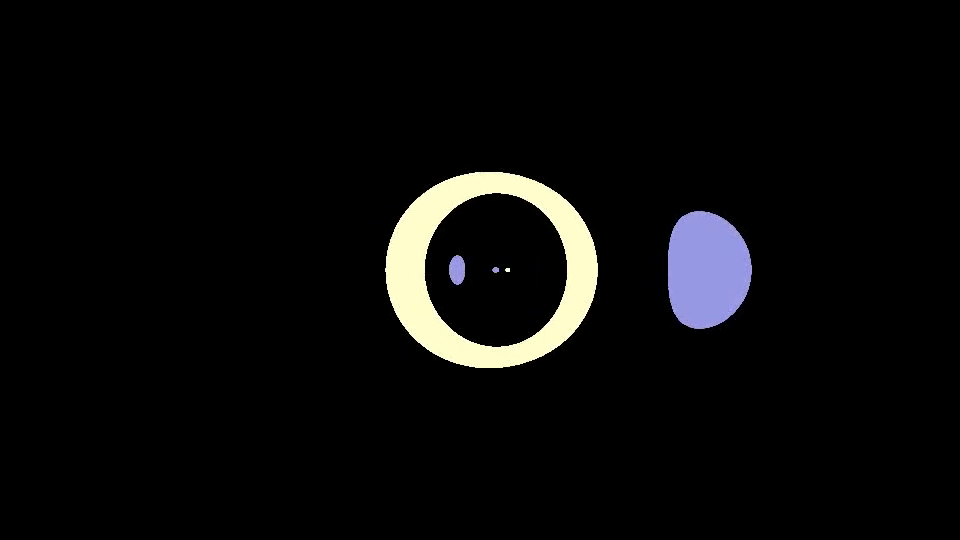 Blackhole passes stars
The yellow star is actually behind the black hole. However, due to the
gravitational lensing effect, the light is redirected into a ring (known as
the Einstein ring)
around the black hole. The left blue star is a duplicated version of the
original one. Light is bent by the black hole and redirected to the actual
position of the star, passing the back of the black hole.
The video below shows two black holes with
accretion disk
dancing around each other. The gravitational lensing effect is even more
obvious.